
Open-plan offices and collaborative work environments can boost creativity, but they often come with a significant downside: noise. Constant chatter, ringing phones, and HVAC systems create a distracting soundscape that harms focus. Spray foam insulation directly addresses this by creating a quieter, more productive workspace. It works by both absorbing sound waves within its cellular structure and creating a complete air seal that blocks airborne noise from traveling between rooms or from the outside.
How Spray Foam Controls Sound Transmission
Noise travels in two primary ways: through the air (airborne) and through physical structures (structure-borne). Spray foam insulation is uniquely effective because it tackles both.
1. Absorbing Airborne Sound Waves
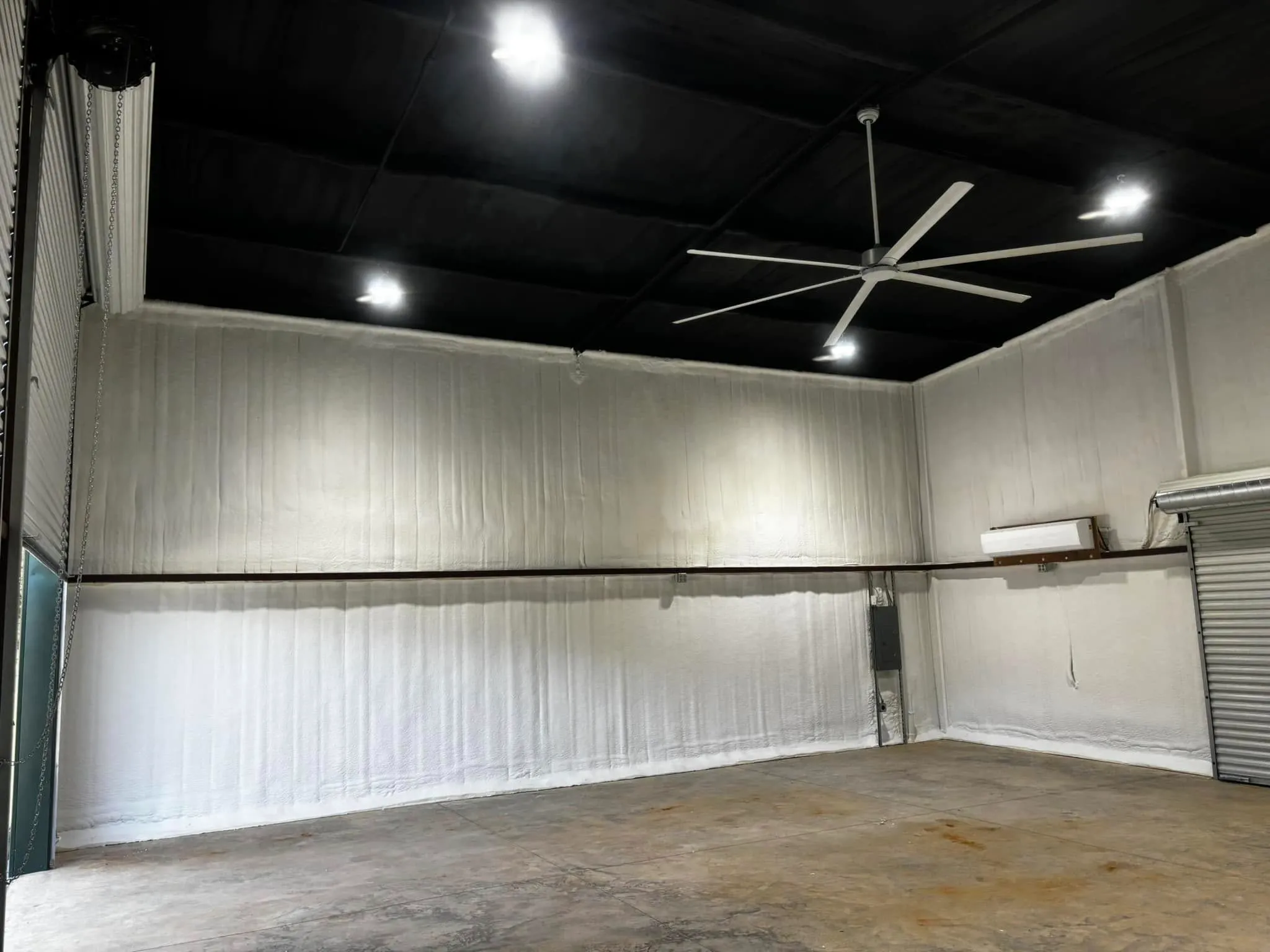
Open-cell spray foam has a soft, porous texture, almost like a dense sponge. When sound waves, which are essentially energy vibrations traveling through the air, hit this surface, they enter the foam’s network of tiny air pockets. As the sound energy bounces around inside these cells, it creates friction and is converted into a minuscule amount of heat. This process, known as sound absorption, effectively deadens the sound rather than letting it reflect back into the room. A study by the Acoustical Society of America points out that uncontrolled sound reflection is a major cause of poor office acoustics.
2. Creating a Monolithic Air Barrier
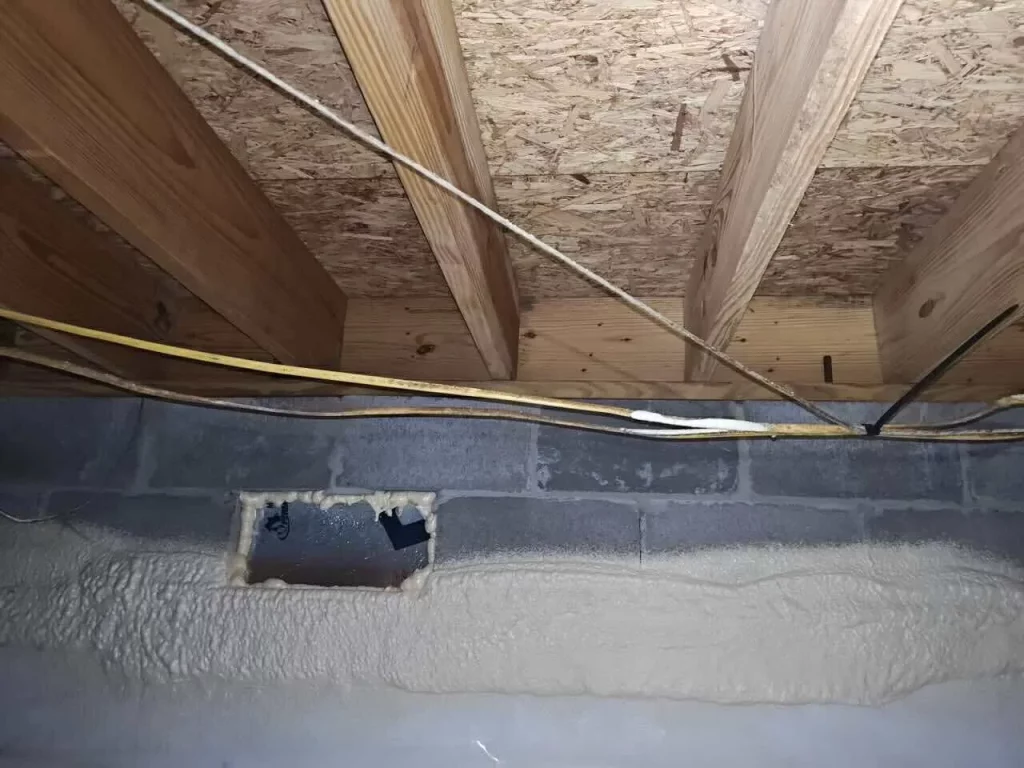
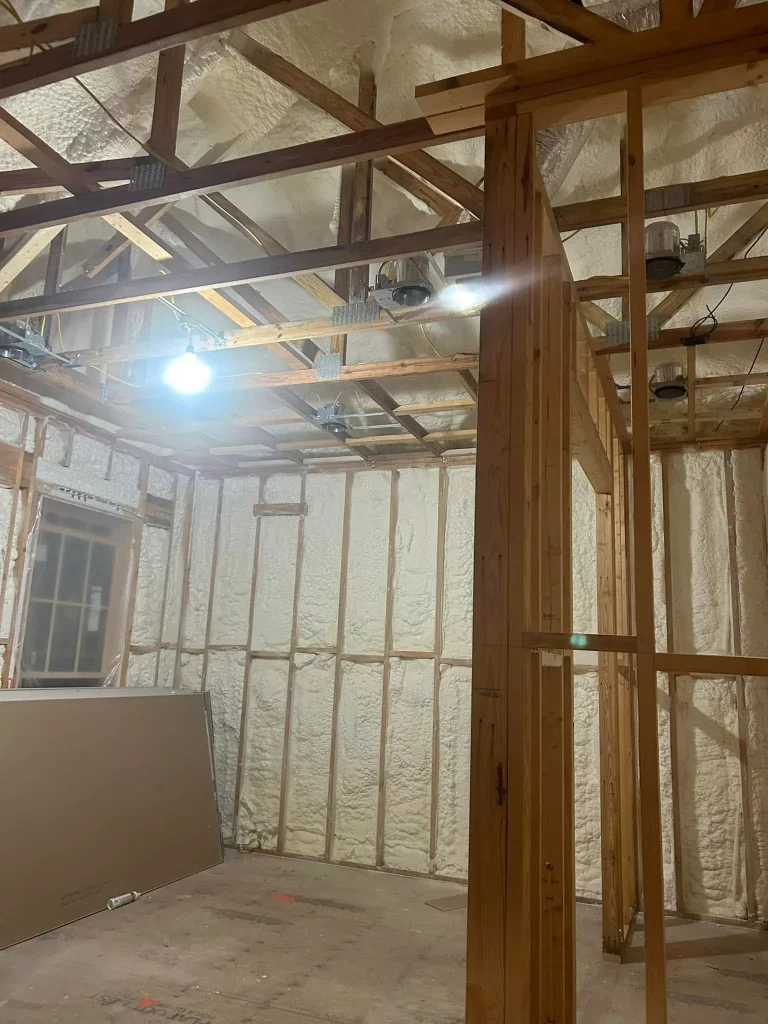
Many office walls are hollow, allowing sound to travel easily through gaps around outlets, light fixtures, and structural joints. Spray foam expands up to 100 times its liquid size upon application, filling every crack and crevice to form a solid, airtight barrier. This monolithic seal eliminates the air gaps that sound waves would otherwise exploit. According to the U.S. Department of Energy, air leakage can be a major path for noise infiltration. By stopping airflow, spray foam effectively stops the noise that hitchhikes a ride with it.
3. Dampening Structural Vibrations
Noise isn’t just airborne. Footsteps from the floor above, the hum of a server room, or vibrations from plumbing are all examples of structure-borne sound. This type of noise travels through solid materials like wood studs, drywall, and pipes. Because spray foam adheres directly to these building components, it acts as a dampening agent. It absorbs the vibrational energy, stopping it from radiating as audible sound into the office space. This is particularly effective in minimizing low-frequency humming and thuds that other insulation types might not affect.
A Look at Different Foam Types for Sound Control
Not all spray foam is the same when it comes to acoustics. The choice between open-cell and closed-cell foam depends on the specific sound issue you need to solve.
| Feature | Open-Cell Spray Foam | Closed-Cell Spray Foam |
|---|---|---|
| Primary Acoustic Function | Sound Absorption | Sound Blocking (to a degree) |
| Structure | Soft, flexible, and porous | Rigid, dense, and compact |
| Density | Low (approx. 0.5 lb/cu. ft.) | High (approx. 2.0 lb/cu. ft.) |
| Best For | Reducing echo, chatter, and mid to high-frequency sounds within a room. | Dampening structural vibrations and blocking some low-frequency noise. |
| Common Application | Interior walls, ceilings, media rooms. | Floors, exterior walls, and mechanical rooms. |
Bonus Tip: For maximum sound control, a hybrid approach can be used. Applying closed-cell foam to the floor assembly to handle impact noise and open-cell foam in the walls to absorb voices is a professional strategy for multi-faceted noise problems.
4. Interrupting Flanking Paths
Flanking noise is sound that finds an indirect route around a sound-blocking wall or floor. For example, sound can travel from one office to another through a shared ceiling plenum, floor joists, or even ductwork. Applying spray foam in these flanking paths seals the connections and creates a discontinuity that stops sound in its tracks. A comprehensive application ensures that sound can’t simply bypass a well-insulated wall by traveling over it or under it.
5. Reducing Impact Noise
In multi-story offices, impact noise from dropped objects or foot traffic can be a constant disturbance. When applied to the underside of a floor deck or between floor joists, spray foam creates a cushioning layer. This layer absorbs the initial shock of an impact, preventing the vibration from traveling through the floor structure and radiating as sound into the space below. While it’s not a complete solution on its own, it significantly reduces the sharp, sudden sounds that are common in busy buildings.
6. Isolating HVAC and Mechanical Noise
The constant hum and rattle from heating, ventilation, and air conditioning (HVAC) systems are major sources of ambient noise. Premier Insulation finds that applying spray foam directly to the exterior of ductwork or insulating the walls of mechanical rooms can effectively isolate this noise. The foam absorbs vibrations from the machinery and airflow, preventing the ducts from vibrating and amplifying the sound throughout the building.
What to Consider Before Insulating for Sound
Before starting a project, it’s important to assess your specific situation. Consider the following factors to ensure you get the results you expect:
- Type of Noise: Are you dealing with high-frequency chatter or low-frequency humming from equipment? Open-cell foam is excellent for voices, while closed-cell might be better for mechanical noise.
- Building Structure: The construction of your walls, floors, and ceilings will dictate the best application strategy. A professional assessment can identify key flanking paths and problem areas.
- Project Goals: Do you need to create a whisper-quiet executive office or simply reduce general background noise in a call center? Your goal determines the required thickness and type of foam.
- Combining Materials: Sometimes, spray foam is best used as part of a larger sound-control system. For extremely sensitive areas, combining it with materials like mass-loaded vinyl or double-layer drywall might be necessary.
Final Thoughts
Managing noise is no longer a luxury in modern office design; it’s a necessity for employee well-being and productivity. Expert insulation installation offers a powerful and versatile solution by absorbing sound, blocking airborne transmission, and dampening structural vibrations. By understanding how it works, you can better plan for a quieter and more focused work environment. Before making a final decision, evaluate the specific types of noise affecting your space and consider a professional consultation to design the most effective strategy.
Get a Professional Assessment
If you’re considering using spray foam to manage noise in your commercial space, getting an expert opinion is the best first step. The team at Premier Insulation can help you analyze your office’s acoustic challenges and determine the right solution. Contact a specialist for an assessment by calling (229) 554-3939 today. A clear plan ensures you invest in a solution that delivers real results.
Frequently Asked Questions
How thick should spray foam be for effective noise reduction?
For interior walls, a typical application of 3.5 inches of open-cell foam (filling a standard 2×4 wall cavity) is highly effective for reducing conversational noise. For ceilings and floors, 5.5 inches or more might be recommended to address both airborne and impact noise.
Does spray foam lose its sound-dampening qualities over time?
No. Spray foam is an inert polymer that does not sag, settle, or decompose over time. Once installed, its cellular structure and acoustic properties remain stable for the life of the building.
Can spray foam be applied in an existing office without major disruption?
Yes, it can be retrofitted. The most common method is the “drill-and-fill” technique, where small holes are drilled in the drywall, foam is injected into the cavity, and the holes are patched. This process is relatively quick and minimizes disruption to office operations.
What is the difference between soundproofing and sound absorption?
Sound absorption, what open-cell foam does best, involves trapping sound waves to reduce echo and reverberation within a space. Soundproofing, or sound blocking, is about preventing sound from passing from one space to another. Spray foam contributes to both, but it’s primarily an absorption and air-sealing product.
Can spray foam completely soundproof a room?
No single product can make a room completely soundproof. True soundproofing requires a detailed approach involving mass, decoupling, and absorption. However, spray foam is one of the most effective components in a soundproofing strategy because it excels at absorption and air sealing, which addresses the most common noise pathways. A report from Noise and Vibration Worldwide highlights that distractions from office noise can reduce productivity by up to 66%, making effective sound management a worthwhile investment.
Sources
- U.S. Department of Energy – Provides official information on how air sealing prevents the transfer of air, which also serves as a medium for sound.
- Noise and Vibration Worldwide – A research article that provides data on the significant impact of office noise on employee productivity.